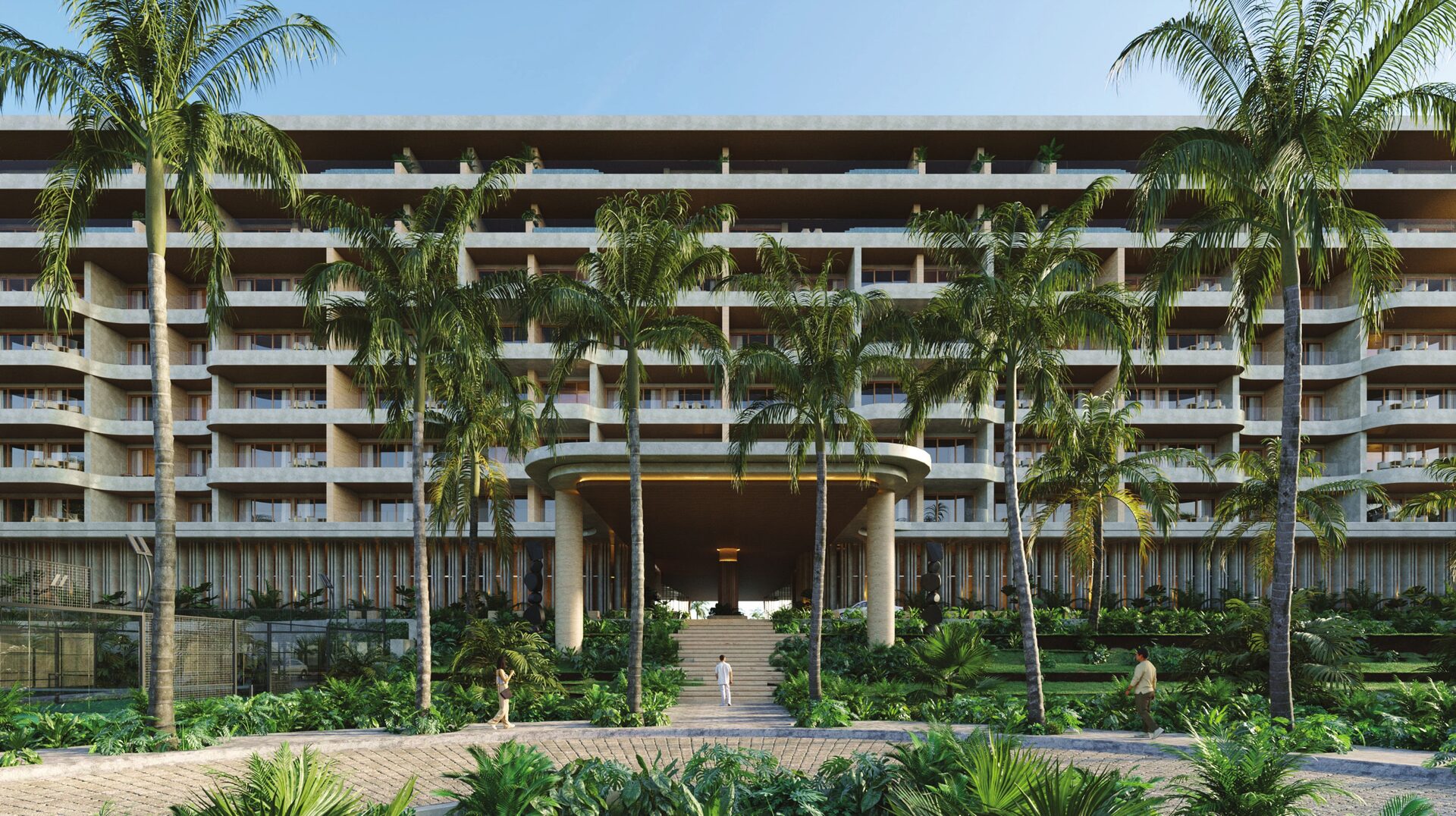
01 — Advance booking
Select and lock in your weeks on the calendar up to 12 months ahead. Ideal for holidays and family dates you'd rather have planned.
 Choose your residence
→

Ownership Model
Discover NOMA
Each residence is deeded into a property fideicomiso (a Mexican trust) — where the rules among owners are recorded — established at a full-service bank regulated by Mexico's National Banking and Securities Commission (CNBV), in which you are a beneficiary with rights of your own over your share.
Your rights do not expire. Your share is tied to the value of the property: it appreciates in the same proportion and can be sold, transferred or passed on to your heirs.
A family may acquire as many shares as they wish, from one up to twelve. Each share entitles you to use the residence four weeks a year.
Using Your Weeks
Select and lock in your weeks on the calendar up to 12 months ahead. Ideal for holidays and family dates you'd rather have planned.
Each week in flexible format is seven nights to use however you like. Come for a weekend and use two, or stay a single night. In this format you don't plan: you go when you feel like it.
Use your weeks through Interval International to book among more than 3,200 affiliated properties in over 90 countries.
Weeks you neither use nor exchange can go into the Rental Program, supported by Wyndham’s commercial platforms. You receive 60% of the rental rate.
Every year, you decide.
Your weeks are not permanently tied to any single way of using them.
Annual Calendar
The annual calendar is organized into 25 Gold weeks and 25 Silver weeks, plus two maintenance weeks. Each share entitles you to two weeks in each category. Weeks run Monday to Monday.
Swipe to explore all twelve months
Explore how the weeks will be distributed, using the 2030 calendar as a reference. Weeks run Monday to Monday. Check-in from 4:00 p.m. and check-out at 11:00 a.m.
The structure never changes: the number of weeks in each category is always the same. What changes are the dates, because long weekends, Easter and spring break fall differently each year. That is why NOMA publishes the calendar annually, with Gold and Silver weeks clearly identified, before bookings open.
Maintenance & Rental Program
Maintenance on your share is $60,000 MXN a year: $15,000 per week. It covers the full operation of the residence and the amenities, to Registry Collection standards.
The Rental Program is designed so that occupancy covers the maintenance on your weeks and generates additional income.
Weeks in the Rental Program take part in a rental pool supported by Wyndham's commercial platforms and systems. Payment is calculated on the rental income achieved across all weeks operated in the program, not on your weeks specifically.
Here you can see how your maintenance cost behaves at different occupancy levels.
These scenarios are illustrative and show the potential of the Rental Program at different occupancy levels. Actual results will depend on the rates and occupancy achieved and may be lower or higher than the examples shown. Participation is subject to the terms and conditions of the Rental Program.
And if you decide to use all four of your weeks, there is no better use of them: you paid $15,000 for a week that costs the general public $78,000. And as an owner, your food and beverage spending carries a 40% discount.
Domestic & International Markets
Mexican travelers come in summer, at Easter and on long weekends. Travelers from the United States and Canada come from October to March, escaping the winter. They are two distinct high seasons, and they don't overlap.
That is what makes the model work: you reserve the weeks in your season and the rest are rented during the other market's high season. Your unused weeks are not empty weeks.
You reserve your Gold weeks on the calendar and your Silver weeks go to rental, during the period of highest international demand.
You book all four of your weeks within the Silver season — even back to back — and it's your Gold weeks that generate income during the dates of highest domestic demand.
Trade a week on the beach for a week on the slopes, while someone leaves the snow to come to your beach.
Frequently Asked Questions
Everything needed for the residence to operate and stay ready at all times. There are no additional utility charges and no special assessments for ordinary operations.
Electricity, water, gas and all other utilities for the residence and the amenities. You can run the air conditioning without restrictions or usage charges.
The fee covers the property tax, the insurance on the residence and its facilities, and the trust fees. You do not pay them separately.
The full operating payroll: management, housekeeping, hosts, servers, bussers and the rest of the property's service staff.
Maintenance of the structure, the installations, the appliances and every amenity: pools, spa, fitness center, beach club, common areas and gardens.
A reserve for the depreciation and renewal of furnishings, so the residence always stays in prime condition.
Bed linens, towels, dishware, glassware, flatware, table linens, décor and all equipment, to the standards of Registry Collection Hotels, by Wyndham.
You worry about nothing: you pay your maintenance and arrive at your home to hotel service.
The fee covers only the operation and upkeep of the property, and is separate from the process and payment terms for acquiring a share.
Your annual term runs from the date you acquire your share and renews on that same anniversary each year, at the rate then in effect.
No two owners are alike: you can place all four weeks in the Rental Program, book them all on the calendar, or combine use, exchange and rental however you prefer. The structure adapts to whatever you decide each year.
At the start of each annual term you pay 50% of the fee. That payment activates all four of your weeks for booking on the calendar.
With the initial payment you can already enter the calendar and book dates up to 12 months ahead. You don't need to decide which ones from the outset.
What you do define within the first 60 days is how many weeks you assign to each option:
The deadline applies to the decision, not to the dates: once your structure is set, you choose and adjust your dates throughout the year.
Simply letting us know you'll use all four weeks, or booking them on the calendar, is enough to hold them for your own use all year. You don't need to mark any date: the weeks you don't book remain in flexible format and you can claim them whenever you like, subject to availability.
If the 60 days pass with no notice and no calendar bookings, we place two of your weeks in the Rental Program and you keep the other two for your own use. We do this for your benefit: those two weeks go to work covering your fee instead of going unplaced. The two you keep remain available for you to use whenever you like.
The initial 50% equals the maintenance on two weeks and is applied to the last two you use in your annual term.
By the end of your annual term you will have paid your fee in full, regardless of the combination you chose.
Your fee covers all four weeks of the year, whether or not you use them. If you place weeks in the Rental Program, their maintenance is covered by the income they generate; if you reserve them for your own use or for exchange, you cover them yourself.
Worth keeping in mind when you set your structure: if you declare four weeks of personal use and end up using only two, the other two remain your responsibility, because by then they could no longer be placed in rental. Your initial payment covers two; the rest is settled at year-end.
At the end of your annual term, Rental Program income is reconciled against the maintenance owed on those weeks. If the income exceeds it, the difference is deposited to you. If it falls short, you cover the shortfall — an unlikely scenario, but one worth being clear about: the maintenance fee is an obligation of every owner, regardless of how they use their weeks.
When you assign a week to exchange, NOMA deposits the corresponding points into your Interval account, which you use to book the property and dates you prefer within the network. All deposited weeks receive the same point weighting, with no distinction between Gold and Silver, at a value sufficient to exchange into Elite-tier properties.
The number of weeks you assign to exchange is set within the first 60 days. Points are deposited when you request them, once that week's maintenance has been paid — the same as if you were coming to the property. Exchange also carries a fee of Interval International's own, currently around USD $250 per week, which is separate from NOMA.
The fee is not a discretionary figure: it is calculated by professional hotel managers and covers what is required to maintain and operate the property to the standards needed to keep it in perfect condition.
Each year owners receive financial statements audited by an internationally recognized firm, along with the information supporting the following year's fee. The fee is adjusted solely according to what the operation requires.
Each share carries a voice and a vote in the owners' assembly, in proportion to its interest, on decisions about the management of the development — including the power to replace the manager.
Assembly decisions are made by a simple majority of the votes present — including the decision to replace the manager. Only decisions affecting the building itself or the condominium regime require a supermajority.
You may cast your vote directly or appoint a representative. The owners of a residence may agree on a common representative to vote all of its shares, but no decision by the other co-owners obliges you to delegate yours. The developer's share may not represent other owners.
Operations are handled by a professional hotel operator, aligned with the standards of Registry Collection Hotels, by Wyndham.
Yes. Every share has the same four weeks a year: two Gold and two Silver. What sets a guaranteed-summer share apart is priority in booking its Gold weeks within the summer, not a different number of weeks.
In practice, not all summer weeks are taken: some owners use only one of their two, and some prefer to book their Gold weeks at other times of year. That inventory is released to the other owners.
And in both cases the limit is the same: two Gold weeks a year. If you used both in summer, those were your Gold weeks for the year.
Yes. A fixed-date booking can be cancelled or reassigned up to one month before the arrival date. The week returns to flexible format, becomes available to other owners, and you keep the right to use it later in the year.
The booking calendar opens twelve months before each date, and works in two stages.
During that period, only the owners of your residence can book it. That's twelve owners, each with four weeks a year across a fifty-two-week calendar.
After that, inventory opens to all owners of residences equivalent to yours. If you own a three-bedroom with an ocean view, you can book in any of the other forty-four in that same category.
In practice, for you not to find the date you want, all forty-five residences in your category would have to be occupied that same week.
Within each stage, bookings are assigned on a first-come, first-served basis.
This opening has another advantage: if your friends are also NOMA owners, you can coordinate to come on the same dates, even if your residences are different.
Yes. Every residence is structured into twelve shares, so acquiring a whole unit means acquiring all twelve of its shares. Use, calendar and rules are the same for every owner.
Buying several shares also carries a volume discount: the more shares you acquire, the better the price per share. You can see it in the pricing tool.
And because they are twelve independent interests, you can later keep them all or sell as many as you wish, one at a time, as the property gains value. It's an asset position you can adjust over time, without having to sell everything at once.
Yes. Each share is independent and sells separately, whenever you decide.
Selling individual shares is usually faster than placing a whole property, and lets you realize value in pieces as the residence appreciates, instead of waiting for a single transaction.
On top of that is the volume discount you bought at: you buy at the price of several shares and sell at the price of one.
Whenever you want and to whomever you want. Once your share is in your name, you can sell it the moment you decide. You need no authorization from the other co-owners and no window to wait for.
You choose the buyer and you set the price. You can do it on your own or draw on NOMA's sales network, which is in constant contact with people interested in joining the project.
You pay nothing. The buyer covers the 5% transaction fee on the value of the sale — which corresponds to the administrative costs of the transfer — plus notary fees and any applicable taxes.
If you prefer to use NOMA's platform and sales team to find a buyer, a 10% marketing fee applies, in addition to the 5% transaction fee.
Anyone acquiring a share — in pre-sale or resale — must complete the trustee institution's identification and acceptance process, in accordance with applicable Mexican regulations.
It's the same standard any bank applies when opening an account, and it serves an additional purpose: it ensures that everyone in the NOMA community has passed that screening. You share your residence with vetted people.
Operations are handled by a professional hotel operator, required to meet the standards and conditions of Registry Collection Hotels, by Wyndham in service, maintenance and operation of the property.
No. The Rental Program is an option, not an obligation. If you want to use all four of your weeks, you use them.
It exists for those who won't occupy all their weeks: it's the way those weeks cover their own maintenance and, depending on occupancy, generate additional income.
The community is governed by a code of conduct that every owner accepts when acquiring their share, enforced by the owners' assembly, where every residence is represented.
The code provides for a proportionate scale of consequences: from a warning for minor infractions to financial penalties when conduct affects the other owners or the operation of the property.
If conduct is serious or repeated, the assembly may resolve to remove the owner. In that case their share is bought back at the original purchase price, less any outstanding financial penalties.
It is an exceptional measure and never one NOMA decides on its own: it requires a resolution of the assembly, with the owners' vote and following the procedure set out in the code.
The share is first offered to the other owners of that residence, with a set period to express interest. Only if none of them takes it does NOMA acquire it.
The purpose is not to punish but to protect what makes this community valuable: that those who belong to it look after the place and the people who share it.
The trust provides for an orderly procedure, designed to keep the residence in perfect condition at all times, to ensure one owner's non-payment doesn't affect the others, and to give anyone going through a difficult year a way out.
Rentals market better when scheduled in advance: the earlier availability is known, the higher the occupancy and the rate that can be achieved. For that reason, if payment hasn't been made after two months, the weeks go straight into the Rental Program. It's the way the owner's own weeks cover their fee and keep their balance as low as possible, instead of going unplaced while the debt is resolved.
With occupancy in line with the market, the income from the four weeks can cover the full late-payment fee. If it does, the owner is current again and regains the use of their weeks in the following annual term. If a balance remains, it is added to the next fee and must be paid within the first 60 days, together with the new year's initial payment.
If it isn't, the same procedure repeats.
Instead of late-payment interest, we apply a single, easy-to-calculate rule: any balance not paid on time is adjusted to 1.5 times its amount.
When the overdue balance exceeds one annual fee and non-payment extends beyond two years, the trust activates a replacement procedure:
The procedure has firm deadlines: it resolves in weeks, not months, so the residence isn't left in limbo.
In both cases the outgoing owner is paid the price at which they acquired their share, less the outstanding balance and any applicable penalty. The residence continues operating normally and the other co-owners do not take on the debt.
The structure is always the same — 25 Gold, 25 Silver and two maintenance weeks; what changes each year are the dates.
A residence with a hotel brand and hotel operation isn't measured only by its construction, but by its ability to generate income and by the demand it creates around it.
Between Rental Program guests and visitors arriving through Interval exchange, more than forty different families stay in your residence each year. Families who come to know the place, the service and the community before ever considering joining it.
Add to them the friends and family every resident brings along. Each stay is an invitation for someone else to discover NOMA: sunrises over the water, meals that run long, days when no one is in a hurry. Those who live it, understand it.
Demand exceeds supply by definition, and that is what sustains the value of your share over time.